
The direct answer
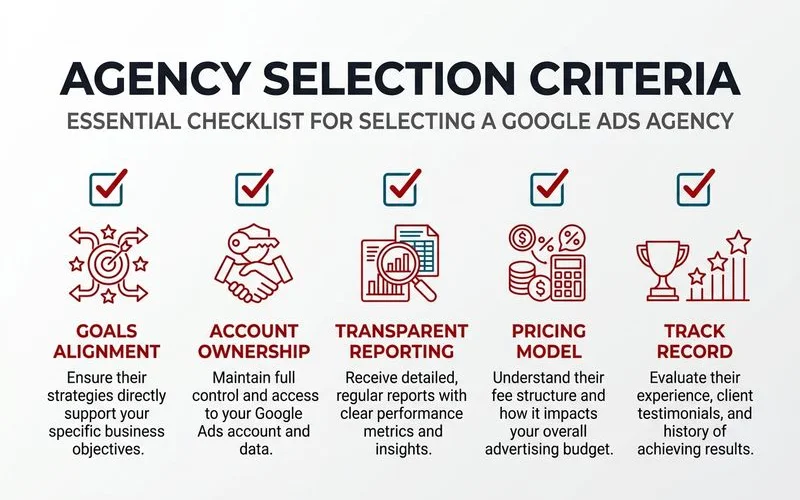
A good Google Ads agency is easy to spot once you know what to look for. Five things predict the fit: clear goals tied to revenue, your name on the account and the data, reporting you can actually read, pricing with no hidden games, and a track record they can show rather than claim. If an agency dodges any of those five, keep looking.
This guide covers the agency types you will meet, the questions that separate real operators from order-takers, and the red flags worth walking away from. If you are still deciding whether to hire at all, our breakdown of running Google Ads in-house versus an agency covers that trade-off first.
The three types of agency you will meet
Most agencies fall into one of three groups, and the right one depends on how much you need handled beyond paid search.
Full-service agencies run SEO, social, content, and ads together. They suit businesses that want one partner for everything, but Google Ads can become one line item among many, managed with less depth than a specialist would bring.
Specialist PPC agencies do paid search and little else. Because Google Ads is the whole business, they tend to stay current with bidding changes, asset formats, and account structure. If paid search is your primary channel, this focus usually shows up in the results.
SEO and SEM agencies, like ours, pair organic and paid so the two channels inform each other. Search query data from ads sharpens the SEO roadmap, and organic rankings reduce how much you pay for the same clicks over time. This works well when you want both channels pulling in the same direction.
What actually predicts a good fit
The old advice lists a dozen factors. In practice, a handful do most of the predicting.
Goals and outcomes, not just clicks
The first conversation should be about your numbers: cost per lead, return on ad spend, or revenue per month. An agency that talks about impressions and clicks before it asks what a customer is worth to you is optimising for the wrong thing.
You keep the account and the assets
Insist the campaign is built under your own Google Ads account, with the agency added as a manager. The same goes for landing pages, ad creative, and conversion tracking. When you own these, leaving costs you nothing but a login change. When the agency owns them, you start from zero somewhere else.
Reporting you can read
Good reporting answers three questions in plain language: what did we spend, what did we get, and what changes next. Be wary of dashboards stuffed with vanity metrics that never connect spend to leads or sales.
Pricing you can see through
Flat retainer or percentage of spend both work. What matters is that you can always separate the agency fee from the money going to Google. If the two are blended into one number, you cannot tell whether your budget is buying clicks or paying overhead.
A track record they can show
Ask for examples in or near your industry, and ask what did not work as well as what did. Honest case studies include the campaigns that needed fixing. A consistent record across a few accounts tells you more than one lucky result.
Certification and ongoing training
Google Partner status and current certifications are a baseline, not a guarantee. They confirm the team keeps up with platform changes, which matter because the auction, the ad formats, and the automation shift every year.
Communication and contract flexibility
You want a named contact who replies in plain English and a contract you can exit without penalty once notice is given. Long lock-ins with no clear off-ramp usually protect the agency, not you.
Red flags worth walking away from
A few signals reliably point to trouble:
- Guarantees of a top position or a fixed number of leads. No one controls the Google auction enough to promise either.
- Refusing to give you admin access to your own account.
- Reports built on impressions and clicks with no line for cost per conversion.
- Contracts with long lock-ins and vague exit terms.
- An inability to explain their method in simple terms. If they cannot describe it clearly, that is usually because there is not much method to describe.
Bringing it together
Pick the agency that is clearest about your goals, your ownership, and your numbers. Depth in paid search beats a long service menu when Google Ads is the channel that has to perform.
If you want a team that runs paid search alongside organic so the two reinforce each other, see how we approach Google Ads management, or talk to ADE Marketing about your account. If SEO is also on your list, the same logic applies when choosing an SEO agency.